
Travel With a Baby: Sleep Tips and a Safer Holiday Checklist
Posted
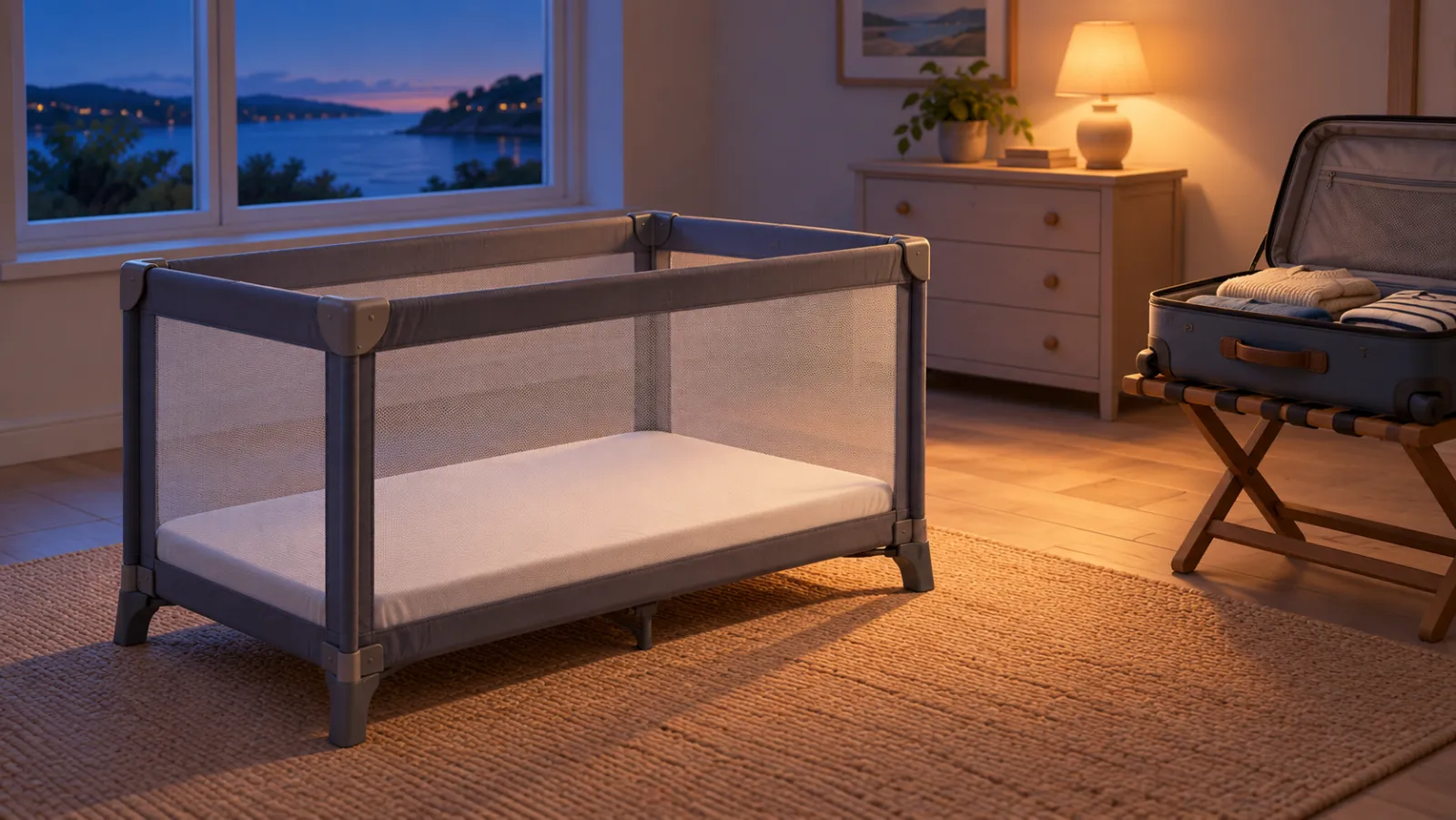
To help your baby sleep while you are travelling, sort out a safer sleep space before you go, pack two or three familiar bedtime cues, and accept that the schedule will move. Follow your baby's feeding and tiredness cues instead of the clock. Once you arrive, rebuild the day from what actually happened, not from the routine you had at home.
Baby Sleep Travel Checklist
- Ask what cot and mattress the accommodation provides, then check both on arrival.
- Keep every sleep space firm, flat and clear, whatever room you are in.
- Take your baby out of the car seat as soon as you reach your destination.
- Pack a short, portable routine. You do not need to recreate the whole nursery.
- Expect naps and bedtime to move. Do not force the clock.
- In hot weather, never block the airflow into a pram with a blanket or cloth.
How Do You Prepare a Travel Cot for a Baby?
Check the travel cot yourself before your baby's first sleep in it. Ring the accommodation before you travel and ask what cot they provide, what condition the mattress is in, and whether clean bedding comes with it.
The Lullaby Trust says a travel cot mattress is fine as a main sleep space as long as it is firm, flat, in good condition and meets British safety standards. Travel cot mattresses are usually much thinner and harder than the one at home. That on its own is not a problem. Do not pad one out with a folded blanket or a quilt to make your baby more comfortable, and do not add a second mattress. If you need a replacement mattress, check the manufacturer's guidance first, because the wrong one can leave a gap at the edge.
On arrival, check the mattress for rips and sagging, check for gaps between the mattress and the sides of the cot, and check that the base is rigid and undamaged. Take pillows, duvets, cot bumpers, pods, nests, toys and weighted bedding out of the sleep space. Then look at where the cot is standing and move it away from blind cords, radiators, windows and air conditioning units.
If another baby has used the cot, ask for it to be cleaned and for fresh bedding.
Can a Baby Sleep in a Pram Carrycot Overnight?
Only if the manufacturer says that carrycot is suitable for overnight sleep. Some are approved for it and some are not, so check the instructions.
The Lullaby Trust says the sleep space must be completely flat, the mattress must be firm and waterproof with no cushioned or raised edges, the hood must pull right back, the apron or cover must come off, and the carrycot must meet British safety standards. Keep an eye on the temperature as well, because the sides of a carrycot can trap more heat than a cot does.
Do not treat a pushchair seat, bouncer, swing, pod or nest as a stand-in for a cot. A baby can slump in these, and slumping affects their airway.
Can a Baby Sleep in a Car Seat While Travelling?
Your baby may well fall asleep in the car seat on the journey, and that is fine, but the car seat should not become their sleep space. The Lullaby Trust says car seats are designed to keep babies safe while travelling and to protect them in a crash, not to be slept in. Take your baby out as soon as you get where you are going and put them down on a firm, flat surface.
UNICEF UK's guide for parents says car seats should only be used for transport for up to two hours at a time (UNICEF UK Baby Friendly Initiative). On a long drive, stop and take regular breaks so you can check your baby, lift them out of the seat and let them stretch and move around. If your baby changes position and slumps forward, stop straight away, take them out and sit them upright before you carry on. If you are driving alone, use a mirror so you can see them. Having a second adult in the back is better.
The Lullaby Trust advises avoiding long drives with pre-term and young babies. Research has found that young babies may be at risk of breathing difficulties if they sleep upright in a seated position for too long, which can increase the risk of sudden infant death syndrome (SIDS), the sudden and unexplained death of a baby.
Where Should Your Baby Sleep If You Are Sharing a Room?
The safest arrangement is your baby in their own clear sleep space, in the same room as you. Travel throws up situations you did not plan for, so read the current Lullaby Trust guidance before you go and agree who is settling the baby, and where, before anyone drinks or gets too tired to think straight.
The Lullaby Trust says not to bed-share at all if:
- your baby was born prematurely, before 37 weeks;
- your baby weighed under 2.5kg (5.5lb) at birth;
- anyone in the bed smokes, or your baby was exposed to smoking during pregnancy;
- anyone in the bed has drunk alcohol, taken drugs, or taken medication that makes them sleepy.
In those situations, put your baby in their own safe sleep space, such as a cot or Moses basket.
Never fall asleep on a sofa or in an armchair with your baby. The Lullaby Trust says this significantly increases the risk of SIDS. It also puts your baby at risk of accidental death, because they can slip into a position where they become trapped and cannot breathe. If you feel yourself getting drowsy, put your baby down on a firm, flat surface.
If you do end up bed-sharing, the Lullaby Trust says to:
- move all adult bedding, duvets and pillows away so your baby has a clear, flat space;
- keep the mattress firm and flat;
- lay your baby near the middle of the bed so they cannot roll out or get trapped between the mattress and the wall;
- remove the headboard if it has any gaps, such as slats, so your baby cannot get stuck, and check that your baby cannot be trapped in the bed frame;
- keep other children and pets out of the bed;
- never leave your baby alone in an adult bed.
Which Bedtime Cues Should You Pack?
Pack two or three cues that travel easily and mean bedtime to your baby:
- the same short phrase or song;
- a familiar sleep bag suitable for the room temperature;
- one short book;
- dim lights and a calm feed;
- the same order of change, cuddle, cot.
That is enough. Your baby recognises the pattern more than the objects. If a comfort item is not safe in the sleep space at home, it is not safe in the sleep space on holiday either.
How Should You Handle Naps on Travel Days?
Take the sleep you can get on a travel day, as long as the sleep space is safe. That may mean a motion nap, which is a nap in the car or the pram, or a short nap at an odd time. Do not try to claw back every missed nap once you arrive. Rebuild the day forwards from the last time your baby woke.
If the naps have been short, an early bedtime is usually easier than stretching an exhausted baby to the usual time. If a late nap happened anyway, let bedtime move later to match.
How Do You Help a Baby Adjust to a New Time Zone?
For a small time difference, you can move straight to local time and let daylight, meals, feeds and the bedtime routine do the work. For a bigger difference, you can shift the routine gradually over a few days instead. Choose whichever suits your baby and your trip.
Once you arrive:
- Get outside in daylight during the local day. The NHS suggests keeping days bright and active, with curtains open and normal noise.
- Keep night feeds and nappy changes dim, quiet and boring.
- Offer naps when your baby is clearly tired, while nudging the day towards local time.
- Avoid a very long late nap if it keeps pushing bedtime out of reach, but do not keep an exhausted baby awake for hours to make the plan work.
- Give it a few days. It will not click on the first night.
Keep feeding responsively throughout, whatever the clock says.
How Do You Keep a Baby Cool on a Hot Holiday?
The Lullaby Trust recommends keeping the room your baby sleeps in at a fairly cool 16–20°C. In a hot country you may not get there, so do what you can: keep the curtains closed during the day, open the bedroom door and a window at night if it is safe to do so, use lighter bedding and fewer layers, and use a fan to cool the room without aiming it at your baby.
To check whether your baby is too hot, feel their chest or the back of their neck rather than their hands or feet. Clammy or sweaty skin means they are getting too hot.
Never cover a pram, buggy or travel system with a blanket, a cloth or any cover that stops the air flowing. Use a clip-on sunshade or a parasol instead. Our guide to baby sleep in hot weather goes into more detail.
What If Your Baby's Routine Falls Apart?
Go back to the smallest familiar sequence you have before you think about buying a new sleep product. Feed, change, dim the lights, say the usual phrase, put your baby in their safe sleep space. Settle them in whatever way your family can keep doing at 3am in an unfamiliar room.
Keep your expectations low for the first couple of nights away, and for the first few nights back home too. If you need to get back to the old schedule, move it in small steps. There is a similar approach in our guide to establishing a bedtime routine.
How Can You Track Sleep Across Time Zones?
Wake Wise saves each entry using the time on your phone. When your phone changes time zone, the timeline can look shifted, so check your entries after you land. The app helps you remember when your baby actually slept. It cannot check a travel cot for you, and it does not replace any of the safety checks above.
Sources and Related Reading
- The Lullaby Trust: Safer sleep on holiday
- The Lullaby Trust: Co-sleeping with your baby
- The Lullaby Trust: Choosing the best car seat for your baby
- UNICEF UK Baby Friendly Initiative: Caring for your baby at night and when sleeping (PDF)
- The Lullaby Trust: Safer sleep in hot weather
- NHS: Helping your baby to sleep
- Baby sleep and the clocks changing
- Baby sleep in hot weather
This article is general information, not medical advice. Follow current manufacturer, NHS, and Lullaby Trust guidance. Ask a qualified health professional for advice about premature or medically vulnerable babies and seek help for breathing, feeding, temperature, or illness concerns.