
White Noise and Red Light for Baby Sleep: The Evidence
Posted
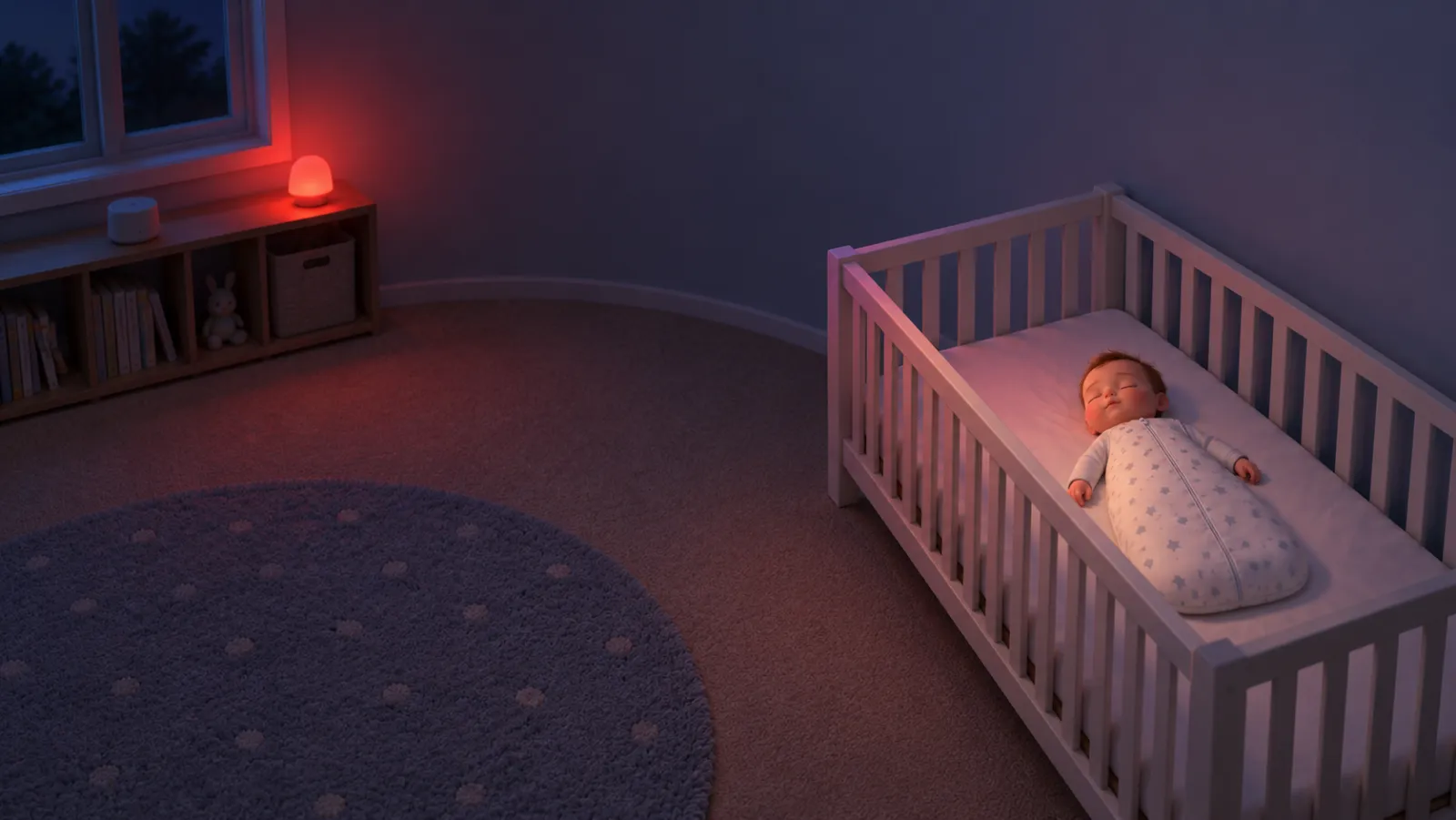
White noise and red light are both sold to help babies sleep, and the evidence behind them is not equal. White noise has small trials behind it, plus a real safety catch about volume. Red light has almost no direct evidence in babies at all. At night, how dim the light is matters more than what colour it is.
Does White Noise Help Babies Sleep?
It can, at least for settling. In a randomised trial of 40 newborns aged 2 to 7 days, 16 of the 20 babies given white noise fell asleep within five minutes, compared with 5 of the 20 left to settle on their own (Spencer et al., Archives of Disease in Childhood, 1990).
That is one small, old study of newborns, so treat it as encouraging rather than settled. White noise also does two plainer things you do not need a trial to see. It masks doorbells, older siblings and traffic. And it keeps the sleep environment the same for every nap and every night, so there is one less thing changing between sleeps.
You will often read that white noise works because it sounds like the womb. That explanation is plausible but unproven, so judge the machine on whether it settles your baby.
Our free white noise player lets you try it before you buy a machine.
How Loud Should White Noise Be for a Baby?
As quiet as you can make it while it still covers the noise you are trying to mask. There is no safe way to run a machine at full volume.
Researchers in Toronto measured 14 infant sleep machines at maximum volume, at distances of 30 cm, 1 metre and 2 metres. Every one was louder than 50 A-weighted decibels (dBA) at 30 cm and at 1 metre. 50 dBA is the noise limit recommended for babies in hospital nurseries. At 2 metres, 13 of the 14 could still go above it. Three went above 85 dBA at 30 cm, which risks noise-induced hearing loss if it runs for more than eight hours (Hugh et al., Pediatrics, 2014). A later review found machines that reach 91 dB at maximum (De Jong et al., Sleep Medicine, 2024).
The Toronto researchers did not tell parents to stop using sleep machines. They gave three precautions instead (Medscape report of Hugh et al.):
- Set the volume as low as you can.
- Put the machine as far from the cot as you can.
- Turn it off once your baby is asleep, or use a timer that does it for you.
In practice, keep the machine at least 2 metres from the cot, the furthest distance the researchers tested, and never in the cot or on the cot rail. The Lullaby Trust advises a clear cot, which means a firm, flat, waterproof mattress and lightweight bedding, and nothing else (The Lullaby Trust).
Children's National Hospital gives parents a number to aim for: under 50 dB, about the level of a soft conversation, with the machine switched off once your baby is asleep (Children's National). A sound level app on your phone is not laboratory equipment, but it will tell you whether you are near 50 dB or nowhere near it. The American Academy of Pediatrics offers a simpler check: if a sound is too loud for an adult, it is probably too loud for a child (HealthyChildren.org).
Is It Safe to Run White Noise All Night?
Nobody knows yet. A 2024 review of 20 studies found that continuous, moderate-intensity white noise harmed early development in animals, that the human data broadly pointed the same way, and that low-intensity noise during sleep may still be helpful. The authors called for limits on how loud and how long these machines can run, and said more research is needed (De Jong et al., Sleep Medicine, 2024).
Until that research exists, the cautious version costs you nothing: keep it below about 50 dB, at least 2 metres from the cot, and turn it off or let a timer stop it once your baby is asleep. Do not leave it running all night.
The American Academy of Pediatrics also warns that the 85 dB limit often quoted for noise exposure was written for adults and should not be assumed safe for children (HealthyChildren.org).
Does Red Light Protect Your Baby's Melatonin?
There is no good evidence that it does in babies, and for a young baby the claim applies less.
Melatonin is the hormone that rises in the evening and makes you feel sleepy. Babies are not born with a melatonin rhythm. A 2024 systematic review found that a stable day-night melatonin pattern usually develops somewhere between the second and sixth month, and in full-term babies was not detected before 9 to 15 weeks (Paditz, Children, 2024). In the early weeks there is very little melatonin there to protect.
The colour argument comes from adult research, and it is more mixed than the marketing suggests. In a study of 14 adults, red light at 10 and 40 lux did not suppress melatonin, while brighter blue light did. But red light at 40 lux still raised markers of alertness in EEG and heart rate (Figueiro et al., BMC Neuroscience, 2009).
The evidence on brightness is clearer, though it is still not from babies. When ten children aged 3 to 5 spent an hour in around 1000 lux before bed, melatonin fell by an average of 88%, and in seven of them it had still not recovered to half its baseline 50 minutes after the light went off (Akacem et al., Physiological Reports, 2018).
So a red night light is a reasonable thing to own, and there is no reason to throw yours out. Keep it dim, and do not expect the colour to do the work.
What Light Should You Use for Night Feeds?
The dimmest light that still lets you see safely. The NHS advises keeping the lights low at night and not playing with your baby, so they learn that night is different from day (NHS).
In practice that means:
- Use one low lamp or night light rather than the ceiling light.
- Point it at a wall or the floor, never at your baby's face.
- Keep the light, its plug and its cable out of the cot and out of your baby's reach.
- Remember that a phone screen at full brightness is a light too.
If you are also working out night feeds, our dream feed guide covers the timing side.
How Do You Set the Room Up?
Start the routine when you see your baby's sleepy cues, then keep everything else the same each time.
- Use wake windows to judge when to start, and adjust them as your baby grows.
- Dim the lights as part of the bedtime routine, which the NHS suggests as a way to create a calm atmosphere.
- Turn white noise on at a low volume, at least 2 metres from the cot, and turn it off once your baby is asleep.
- Keep the cot itself clear.
A baby sleep tracker makes it easier to see whether a change to the room altered anything, instead of judging it on one rough night.
Will My Baby Become Reliant on White Noise?
Probably, in the sense that white noise is a sleep association like any other. Your baby may come to expect it, which is worth planning for. Take the sound with you when you travel, or fade the volume down over several nights if you want to drop it. Our guides on general sleep tips and sleep away from home both cover keeping a routine when the room changes.
Watch how your baby responds and change the room when something stops working for them.
Sources and Related Reading
- Spencer et al.: White noise and sleep induction, Archives of Disease in Childhood, 1990
- Hugh et al.: Infant sleep machines and hazardous sound pressure levels, Pediatrics, 2014
- Medscape: 'Sleep' machine noises loud enough to impair baby's hearing (report of Hugh et al.)
- De Jong et al.: Continuous white noise exposure during sleep and childhood development, Sleep Medicine, 2024
- HealthyChildren.org: AAP sounds the alarm on excessive noise and risks to children
- Children's National: The truth about baby sound machines and hearing loss
- Paditz: Postnatal development of the circadian rhythmicity of human pineal melatonin, Children, 2024
- Figueiro et al.: Both blue and red light can induce alertness at night, BMC Neuroscience, 2009
- Akacem et al.: Sensitivity of the circadian system to evening bright light in preschool-age children, Physiological Reports, 2018
- NHS: Helping your baby to sleep
- The Lullaby Trust: Keeping a clear cot
This article is general information, not medical advice. Follow current NHS and Lullaby Trust safer sleep advice. If your baby is persistently hard to settle, snoring heavily, struggling to feed, not gaining weight, or if you have any concern about their hearing or their sleep, speak to your GP, midwife or health visitor.